When it comes to affordable government-backed life insurance in India, two names often come up: RPLI vs PLI. If you are trying to decide which one is better for you, you are asking the right question. Many people get confused because both are government-backed, both look similar, and both give good returns. But they are made for different types of people.
Many people choose a plan without understanding it properly and later regret it. The good thing is that once you understand the RPLI vs PLI difference, the decision becomes much easier. In this guide, you will learn about RPLI Eligibility and PLI Eligibility, their benefits, and how tools like the RPLI Calculator and PLI Calculator Online can help you compare and choose the right plan.
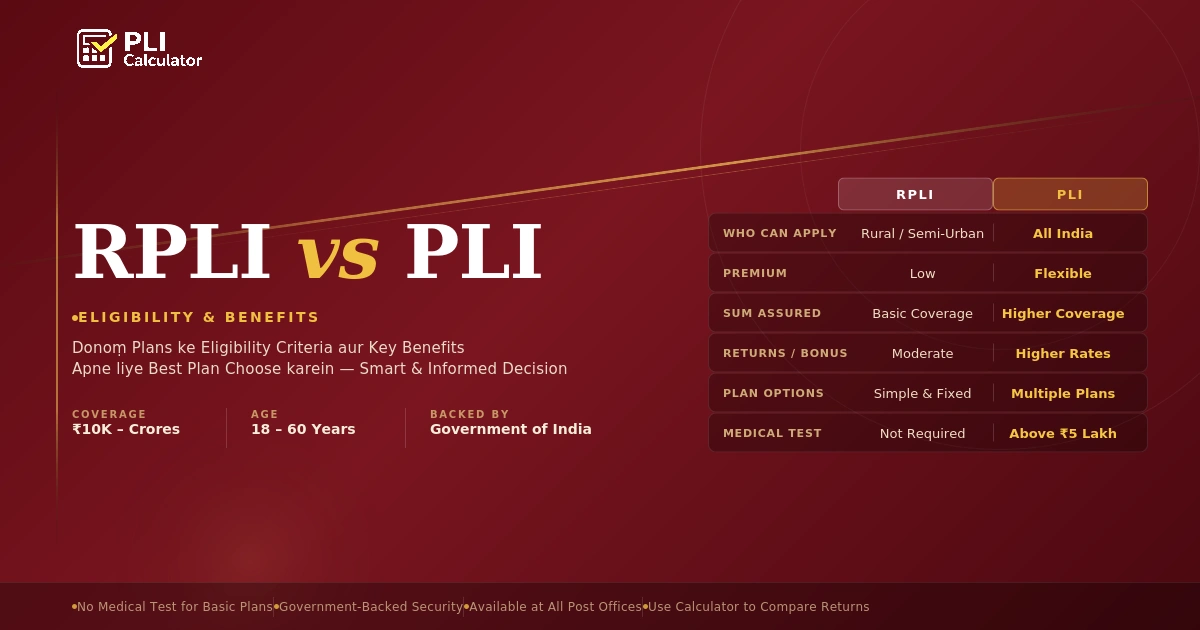
RPLI vs PLI — Eligibility, Benefits, and Key Differences Explained
What Are RPLI and PLI?
RPLI (Rural Postal Life Insurance)
RPLI is a life insurance plan offered by India Post for people living in rural and semi-urban areas. It is simple and affordable. The premium is low, and the process is easy. It mainly focuses on giving basic financial protection with steady returns.
PLI (Postal Life Insurance)
PLI is also offered by India Post but is available for people across India. It has more options and flexibility. You can choose from different plans like endowment, whole life, and money-back policies. It also allows higher coverage and better returns compared to RPLI.
📖 Read More Related Blog
📋 PLI Interest Rate 2026: Updates, Features & EligibilityCheck interest rates, maturity benefits & how PLI works →
RPLI vs PLI: Key Differences
| Aspect | RPLI (Rural Postal Life Insurance) | PLI (Postal Life Insurance) |
|---|---|---|
| Target Customers | Rural and semi-urban people | All people across India |
| Premium Range | Low premium options | Wide premium range |
| Sum Assured | Lower coverage | Higher coverage |
| Plan Options | Limited plans | Multiple plans |
| Bonus | Moderate bonus | Higher bonus rates |
| Flexibility | Simple and fixed | Flexible options |
| Accessibility | Post offices | Post offices and other channels |
RPLI Eligibility
Age Requirements
You must be between 18 and 55 years old to apply for RPLI. The younger you are when you apply, the lower your premiums will be, and the longer your policy can run.
Residence & Location
RPLI is for people living in rural and semi-urban areas of India. If you are unsure whether your location qualifies, check with your nearest post office as they maintain official lists of eligible areas.
Income Considerations
There is no strict minimum income requirement, but your sum assured should match your financial capacity. For someone earning ₹20,000 monthly, a sum assured of ₹5,00,000 might be reasonable, whereas ₹50,00,000 would raise questions.
Health & Medical Tests
Generally, no medical examination is required for RPLI policies. You simply fill out a health declaration form honestly. However, if you have pre-existing serious health conditions, you should disclose them during application.
Documentation Needed
- Basic ID proof (Aadhar or Voter ID)
- Address proof (ration card or utility bill)
- A completed proposal form
- Bank details for premium payment
Occupational Restrictions
Most occupations are eligible for RPLI. However, if your job involves dangerous conditions (mining, heavy construction, chemical handling), you may face additional scrutiny or higher premiums.
PLI Eligibility
Age Requirements
PLI applicants must be between 19 and 55 years old for most plans. However, the Whole Life Assurance plan allows applications up to age 60, giving older applicants more options compared to RPLI.
Geographic Accessibility
Anyone across India can apply, whether you’re in metro cities, tier-2 towns, or villages. This broader accessibility is a major RPLI vs PLI difference that affects many urban Indians.
Income & Sum Assured Matching
PLI has more flexible sum assured options ranging from ₹50,000 to several crores. Your income should reasonably support your chosen sum assured, but there’s more flexibility here.
Medical Examination Policy
For sum assured up to ₹5,00,000, no medical test is required. Beyond that, India Post may mandate health checkups to ensure insurability and assess risk accurately.
Documentation Requirements
- Valid ID proof (Aadhar, PAN, Passport, Voter ID)
- Address proof (utility bill, rent agreement, official document)
- Income proof (salary slip, IT returns, business registration)
- Bank account details for premium debit
Occupation & Risk Assessment
PLI has broader occupational acceptance. Even high-risk occupations can apply, though they may face additional scrutiny, higher premiums, or specific exclusions in their policy.
📖 Read More Related Blog
⚖️ PLI vs PPF: Returns, Tax Benefits & Maturity Comparison 2026Complete comparison — returns, tax savings & maturity value →
Using Calculators to Compare Returns
Before choosing between RPLI vs PLI, it is suggested to check returns using the calculators.
RPLI Calculator
The RPLI Calculator helps you estimate your maturity value based on premium, age, and policy term.
PLI Calculator Online
The PLI Calculator Online helps you compare different plans and expected returns easily.
Whole Life Assurance Calculator
This tool shows how your investment grows over time and what your family receives.
Money-Back Calculator
It helps you understand when you will receive payments and the final maturity value.
Surrender Value Calculator
This calculator shows how much money you will get if you close your policy early.
RPLI vs PLI: Which One is Best?
Choose RPLI If:
- You live in a rural or semi-urban area
- Your budget is limited
- You want a simple plan
- You need basic coverage
Choose PLI If:
- You live in an urban area
- You can pay higher premiums
- You want better returns
- You need higher coverage
Choosing between RPLI vs PLI depends on your needs, income, and location. If you want a simple and low-cost plan, RPLI is a good choice. If you want better returns and more options, PLI is the better option. Use tools like the RPLI calculator and PLI Calculator Online before deciding. This will help you make a smart and informed choice.
📖 Read More Related Blog
🏦 RPLI vs LIC: Which Is Better?Premiums, bonus & benefits — detailed comparison →
Frequently Asked Questions (FAQs)
1. What is the main RPLI vs PLI difference?
The main RPLI vs PLI difference is that RPLI is for rural areas with simple plans, while PLI is for all with better options and returns.
2. Who can apply under RPLI Eligibility?
People living in rural or semi-urban areas between 18 and 55 years can apply.
3. What is PLI Eligibility?
Anyone in India aged between 19 and 55 years can apply, depending on the plan.
4. Which calculators should I use?
You can use the RPLI Calculator, PLI Calculator Online, Money-Back Calculator, and Surrender Value Calculator to compare returns.
5. Which has better benefits?
PLI Benefits are generally higher, but RPLI Benefits are suitable for low-income and rural users.