Both RPLI and LIC are government-backed insurance options, but they’re designed for different people and different situations. One is designed specifically for rural communities with smaller premiums, while the other is a full-service insurance giant offering comprehensive coverage across the country.
Once you understand how each works and see the real numbers, choosing becomes straightforward. If you’re confused about RPLI vs LIC which is better, then you are in the right place. This guide will walk you through everything about RPLI calculator, show you actual maturity values, give you a detailed comparison, and help you figure out which one truly fits your needs.
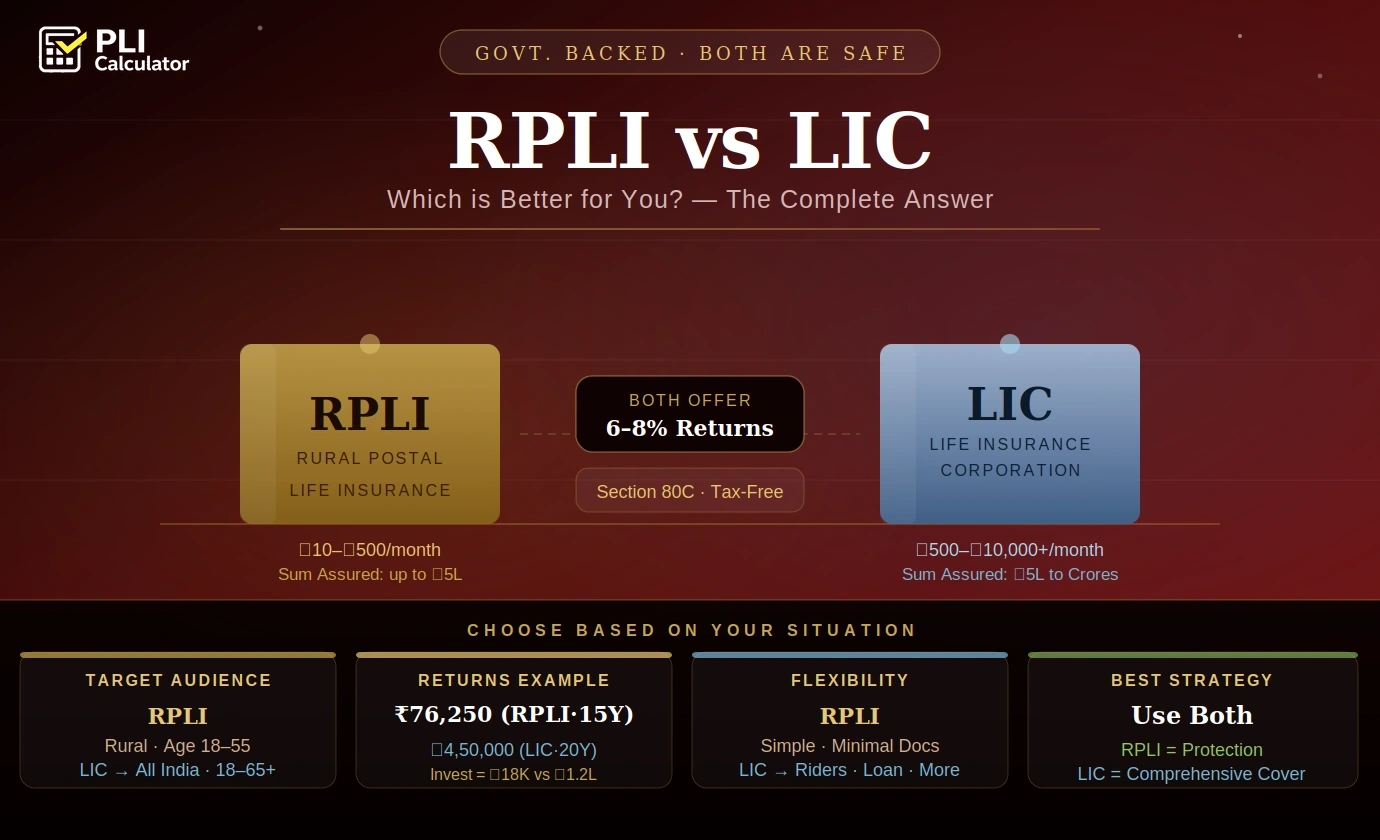
RPLI vs LIC — A complete comparison to help you choose the right government-backed insurance for your needs.
Understanding RPLI and LIC
What is RPLI (Rural Postal Life Insurance)?
RPLI, or Rural Postal Life Insurance, is India Post scheme for affordable life insurance for people in rural and semi-urban areas. Few things that makes it special are:
- Affordable premiums specifically designed for rural communities
- Lower sum assured compared to traditional life insurance (typically ₹1,000 to ₹5,00,000)
- Simple documentation with minimal paperwork required
- Bonus earnings that accumulate annually just like other postal schemes
- Tools available like the RPLI calculator and RPLI maturity calculator to estimate your returns
What is LIC (Life Insurance Corporation)?
LIC, or Life Insurance Corporation of India, is the country’s largest life insurance provider. It has been around for decades and serves millions of customers nationwide:
- Wide range of plans from term insurance to endowment to money-back policies
- Higher sum assured options ranging from ₹5,00,000 to several crores
- Comprehensive coverage with additional riders and benefits
- Pan-India presence with offices in every city and town
- Various calculators available for different plan types
RPLI vs LIC: Comparison Table
| Feature | RPLI (Rural Postal Life Insurance) | LIC (Life Insurance Corporation) |
|---|---|---|
| Target Audience | Rural and semi-urban populations | All segments across India |
| Premium Amount | Low & affordable (₹10–₹500 monthly) | Varies widely (₹500–₹10,000+ monthly) |
| Sum Assured Range | ₹1,000 to ₹5,00,000 | ₹5,00,000 to several crores |
| Returns Structure | Fixed bonus (₹25–₹40 per ₹1,000) | Depends on plan type |
| Government Backing | Yes (India Post) | Yes (Government of India) |
| Policy Term | 10–20 years | 10–40+ years (varies by plan) |
| Eligibility | Age 18–55 years | Age 18–65+ years |
| Flexibility | Limited | Extensive (riders, loan options) |
| Tax Benefits | Section 80C | Section 80C |
| Maturity Payout | Sum Assured + Bonus | Depends on plan |
How RPLI and LIC Actually Work?
RPLI Returns Example
Let’s say you’re in a rural area and decide to invest ₹100 monthly in RPLI for 15 years with a sum assured of ₹50,000. Here’s what happens at maturity:
- Total premium paid: ₹18,000 (₹100 × 12 × 15)
- Sum assured: ₹50,000
- Annual bonus (at ₹35 per ₹1,000): ₹1,750 per year
- Total bonus over 15 years: ₹26,250
- Final maturity amount: ₹76,250 (₹50,000 + ₹26,250)
- Profit: ₹58,250 on just ₹18,000 investment
This is why the RPLI calculator and RPLI maturity calculator are so useful—they show you these exact projections before you commit.
📖 Read More Related Blog
📋 RPLI vs PLI: Eligibility, Benefits & Key Differences ExplainedWho can apply & how RPLI differs from PLI →
LIC Returns Example
Now consider an LIC Endowment plan with:
- Monthly premium: ₹500
- Sum assured: ₹2,50,000
- Policy term: 20 years
- Expected bonus: ₹40 per ₹1,000
See How Your Money Grows
- Total premium paid: ₹1,20,000 (₹500 × 12 × 20)
- Sum assured: ₹2,50,000
- Annual bonus: ₹10,000 (₹2,50,000 × 40/1,000)
- Total bonus over 20 years: ₹2,00,000
- Final maturity amount: ₹4,50,000 (₹2,50,000 + ₹2,00,000)
- Total profit: ₹3,30,000
The difference in coverage and returns is significant, which is exactly why people use various calculators to compare different products.
RPLI vs LIC: Which is Better?
The answer to this question depends entirely on your situation.
Choose RPLI If You:
- Live in a rural or semi-urban area
- Have a limited budget for life insurance
- Want simple, straightforward coverage without complicated features
- Prefer affordable premiums with decent returns
- Don’t need very high sum assured amounts
Choose LIC If You:
- Live in an urban area with easy access to LIC offices
- Can afford higher premiums for better coverage
- Want comprehensive life insurance with multiple options
- Need higher sum assured amounts (above ₹5,00,000)
- Want flexibility with riders and additional benefits
📖 Read More Related Blog
⚖️ PLI vs PPF: Returns, Tax Benefits & Maturity Comparison 2026Complete comparison — returns, tax savings & maturity value →
Tax Benefits: How Both Compare
Both RPLI vs LIC offer similar tax benefits under Section 80C:
RPLI Tax Advantages:
- Premium is fully deductible under Section 80C (up to ₹1.5 lakh annual limit)
- Maturity amount and bonus are tax-free
- Simple tax filing with no complications
LIC Tax Advantages:
- Premium is deductible under Section 80C
- Maturity amount is tax-free
- Bonus is generally tax-free in most plans
- Some plans offer additional tax benefits
Since both are equally attractive from a tax perspective, so this shouldn’t be your deciding factor.
Using Calculators to Decide
When comparing RPLI vs LIC, using the right calculators is absolutely crucial for making informed decisions.
RPLI Calculator
Start with the RPLI calculator to understand what your investment would look like under basic RPLI plans. This gives you a baseline. Then, use specific plan calculators based on which RPLI variant interests you most.
Gram Santosh Maturity Calculator
If you’re interested in the Santosh endowment plan, one of RPLI’s most popular offerings, the Gram Santosh Maturity Calculator will show you exactly how much you’ll receive at maturity, including bonuses. This calculator is specifically calibrated for the Santosh plan’s bonus structure.
Gram Suraksha Calculator
For those seeking basic death protection along with some returns, the Gram Suraksha Calculator helps you understand the Suraksha plan’s maturity value. This plan is perfect for people who want minimal premium burden but maximum protection.
Gram Sumangal Money-Back Calculator
If regular income during your working years appeals to you, the Gram Sumangal Money-Back Calculator is invaluable. This plan returns portions of your sum assured at regular intervals (typically every 5 years) while still maintaining full coverage.
Gram Priya Calculator
For women investors, the Gram Priya Calculator opens up special RPLI schemes designed exclusively for women, often with lower premiums and enhanced benefits.
RPLI suits rural areas with tight budgets, low premiums, simple process, decent returns. LIC works for urban earners wanting comprehensive coverage and flexibility. Many use both for complete protection. Once you’ve run these RPLI calculators, compare the maturity values with LIC’s offerings using their official calculators. The comparison becomes crystal clear when you see real numbers side-by-side.
📖 Read More Related Blog
📋 PLI Interest Rate 2026: Updates, Features & EligibilityCheck interest rates, maturity benefits & how PLI works →
Frequently Asked Questions (FAQs)
1. What is the main difference between RPLI vs LIC?
RPLI is affordable insurance for rural areas with low premiums, while LIC is a comprehensive provider offering higher coverage and flexibility across all segments.
2. Can urban residents buy RPLI insurance?
Yes, but RPLI is optimized for rural populations—urban residents can buy it through post offices, though LIC plans usually offer better flexibility and higher coverage limits.
3. Which gives better returns, RPLI or LIC?
Both offer 6–8% effective returns; RPLI excels in affordability while LIC excels in coverage flexibility and higher return potential based on specific plans.
4. Which is more safer between RPLI and LIC?
Both are safer as they are government-backed, RPLI by India Post and LIC by the Government of India, so your money and coverage are completely secure with either option.
5. How do I use the Gram Santosh Maturity Calculator?
Simply enter your age, monthly premium, desired sum assured, and policy term to instantly see your projected maturity value including bonuses and compare easily with other RPLI variants.