Choosing between PLI vs PPF is one of the most common difficulties for Indians. Both are government-backed, safe investment options, but they work very differently. If you’re confused about which one suits your needs, you’re not alone. Let me break it down for you in simple terms. When it comes to long-term financial planning, most Indians find themselves in confusion about the PLI scheme vs PPF.
The confusion is real because both options promise safety, tax benefits, and decent returns. However, they serve fundamentally different purposes. Once you understand how each works and see the real numbers, choosing becomes much easier. So we have provided everything you need to know about PLI vs PPF in Post office to help you make the right decision for your financial goals.
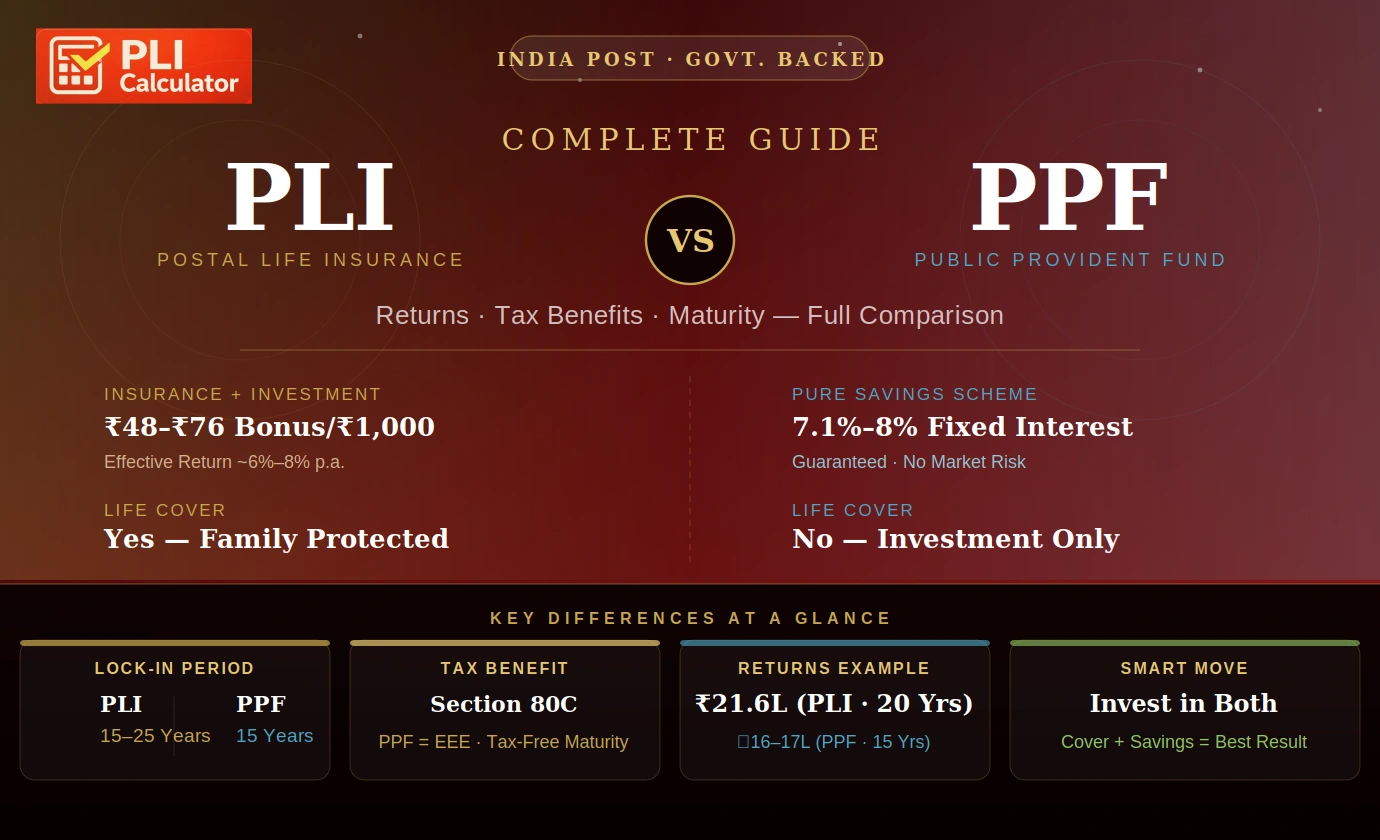
PLI vs PPF — A complete comparison of returns, tax benefits, and maturity for Indian investors in 2026.
Understanding PLI and PPF
Before we start the comparison, let’s clarify what each option actually offers. One combines insurance with savings, while the other focuses purely on wealth accumulation.
What is PLI (Postal Life Insurance)?
PLI, or Postal Life Insurance, is offered by India Post as a hybrid product that combines insurance protection with investment growth.
- Life insurance coverage for your family’s financial security
- Bonus earnings that accumulate over the policy term
- Popular plans like Endowment Assurance (Santosh) with fixed maturity periods
- Tools available like the PLI calculator and PLI Surrender Value Calculator to estimate returns before investment
What is PPF (Public Provident Fund)?
PPF, or Public Provident Fund, is a pure government-backed savings scheme with no insurance component. It’s designed purely for wealth accumulation.
- Fixed interest rates (currently around 7.1%–8% per annum)
- 15-year lock-in period with predictable, guaranteed returns
- Available at banks and post offices (often searched as “PPF vs PLI in Post office” or “PLI scheme vs PPF SBI”)
- Tax-free maturity with significant tax-saving benefits
PLI vs PPF: Quick Comparison
| Feature | PLI (Postal Life Insurance) | PPF (Public Provident Fund) |
|---|---|---|
| Product Type | Insurance + Investment | Pure Investment Scheme |
| Returns Structure | Bonus-based (₹48 to ₹76 per ₹1,000) | Fixed interest (~7.1% to 8%) |
| Risk Level | Very Low | Very Low |
| Lock-in Period | 15–25 years | 15 years |
| Tax Benefit | Section 80C deduction | Section 80C + tax-free maturity (EEE) |
| Maturity Value | Sum Assured + Accumulated Bonus | Principal + Interest |
| Liquidity | Limited (surrender/loan options) | Better flexibility with partial withdrawals |
| Life Insurance Cover | Yes | No |
When comparing PLI scheme vs PPF SBI, remember that PLI is exclusive to India Post while PPF is available at both SBI and post offices—choose based on convenience and which product fits your actual financial goals, not just the institution.
📖 Read More Related Blog
📋 PLI Interest Rate 2026: Updates, Features & EligibilityCheck interest rates, maturity benefits & how PLI works →
What Actually Happens With Your Money
What PPF Actually Returns?
Let me give you a real scenario. Suppose you decide to invest ₹5,000 every single month into PPF for 15 years at an interest rate of roughly 7.5% per year. So at the end:
- Total money you put in: ₹9,00,000 (that’s ₹5,000 × 12 months × 15 years)
- What you get back: ₹16–17 lakh (the exact amount depends on how interest rates change over time)
- Your profit: ₹7–8 lakh—that’s pretty solid!
This is exactly why smart investors use a PPF vs PLI Calculator before putting their money anywhere.
What PLI Actually Returns?
Imagine, you take a calculator with these details:
- How much coverage you want = ₹10,00,000
- Duration = 20 years
- The bonus rate = ₹58 per ₹1,000
See How Your Money Grows
- Bonus you receive each year: ₹10,00,000 × (58/1,000) = ₹58,000 annually
- After 20 years, your total bonus: ₹58,000 × 20 = ₹11,60,000
- Final amount you receive: ₹21,60,000
This is why people spend time with the PLI calculator or the PLI Whole Life Assurance Calculator, they want to see these exact numbers before deciding.
📖 Read More Related Blog
🏦 RPLI vs LIC: Which Is Better?Premiums, bonus & benefits — detailed comparison →
Which One Should You Actually Choose: PPF or PLI?
The honest answer to which is better PPF or PLI is that it completely depends on what you’re trying to achieve:
Go With PLI If You:
- Actually need life insurance to protect your family
- Want the potential for higher returns through bonuses
- Can commit your money for 15–25 years without touching it
- Want to build serious long-term wealth while staying disciplined
Go With PPF If You:
- Just want a simple investment without insurance complications
- Like the idea of withdrawing money when you need it
- Want to save taxes without any headaches
- Prefer knowing exactly what you’ll get at the end
- Don’t need life insurance from your investment
Conclusion
Deciding between PLI scheme vs PPF doesn’t need to be stressful. PLI is your choice if you want insurance bundled with serious long-term wealth building. PPF makes sense if you want tax-free, flexible, guaranteed returns without needing insurance coverage. In reality, the smartest move is often doing both—PLI protects your family while building a big corpus, and PPF gives you liquid, tax-efficient savings for emergencies and extra growth.
Take a calculator, run your own numbers based on your situation, and make a decision you’re comfortable with. Your future self will genuinely thank you for starting now. The Endowment Assurance (Santosh) Calculator can be the shortcut to see the exact amount you’ll have at maturity. Just plug in your details, and it instantly shows you the real numbers without any guesswork.
📖 Read More Related Blog
📋 RPLI vs PLI: Eligibility, Benefits & Key Differences ExplainedWho can apply & how RPLI differs from PLI →
Frequently Asked Questions (FAQs)
1. What is actually difference between PLI vs PPF?
PLI is an insurance plan that doubles as an investment and gives you life cover plus bonus returns. PPF is purely a savings tool that offers fixed interest without any insurance. Both are government-backed, so both are incredibly safe.
2. Which one gives you more returns, PLI or PPF?
PLI can potentially give you higher returns because of bonus payments, sometimes reaching 6–8% effective returns. PPF, though, guarantees you a fixed rate (~7.1%–8%)—you know exactly what you’re getting. Which is “better” really depends on the bonuses PLI declares and how comfortable you are with uncertainty.
3. Is PLI safer than PPF?
They’re equally safe. Both are backed by the Government of India. PLI comes from India Post, PPF is government-managed. Your money is genuinely secure in both cases.
4. Is it okay to invest in both PLI and PPF at the same time?
Absolutely, and honestly, many smart investors do exactly this. Use PLI for insurance and higher return potential, and PPF for flexible, tax-free savings. You get the best of both worlds.
5. How do you actually use a PPF vs PLI Calculator?
You enter your monthly investment amount, how long you want to invest, and for PLI you add the sum assured. The calculator instantly shows you what you’ll have at the end. Most post offices and banks give you these calculators for free.