If you have a PLI policy or are planning to get one, knowing how much money you will actually receive at the end of the policy term is important. Most people just pay their premiums and wait — but you don’t have to. You can calculate your PLI maturity amount on your own using a simple formula, without visiting a post office or using any tool.
In this blog, we have discussed the exact formula used to calculate PLI maturity amount, how it works for each of the six PLI plans, and real examples so you can apply it to your own policy right away.
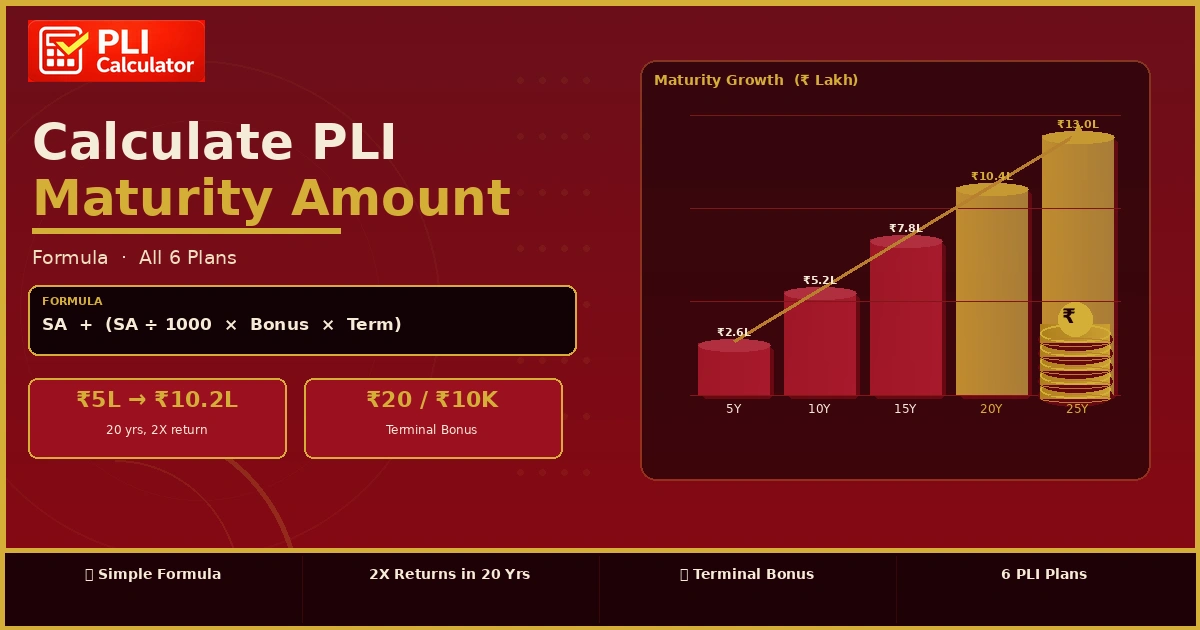
How to Calculate PLI Maturity Amount Manually — Formula Explained with worked examples for all six PLI plans.
What Is PLI Maturity Amount?
The maturity amount is the total money you receive when your PLI policy completes its full term and you survive it. It is not just the sum assured you signed up for — it includes all the bonuses that have accumulated over the years. This is what makes PLI genuinely rewarding for long-term policyholders.
The maturity amount has two parts — the base sum assured and the total bonus earned over the policy term. The bonus is declared every year by the Department of Posts per Rs. 1,000 of sum assured, and it keeps adding up until your policy matures.
The PLI Maturity Amount Formula
Maturity Amount = Sum Assured + (Sum Assured ÷ 1000 × Bonus Rate × Policy Term)
Let’s break it down:
- Sum Assured — the fixed cover amount you chose when buying the policy
- Bonus Rate — the amount declared per Rs. 1,000 of sum assured per year by the Department of Posts
- Policy Term — the number of years your policy runs
This is the core PLI maturity amount formula that works across all plan types. The only thing that changes from plan to plan is the bonus rate and how the payout is structured.
📖 Read More Related Blog
📋 PLI Interest Rate 2026: Updates, Features & EligibilityCheck interest rates, maturity benefits & how PLI works →
Worked Example — How to Calculate PLI Maturity Amount
Let’s take a simple example to make this clear.
Suppose you have a PLI Endowment Assurance (Santosh) policy with:
- Sum Assured — Rs. 5,00,000
- Bonus Rate — Rs. 52 per Rs. 1,000 sum assured per year
- Policy Term — 20 years
- Step 1 — Calculate total bonus: 5,00,000 ÷ 1,000 × 52 × 20 = 500 × 52 × 20 = Rs. 5,20,000
- Step 2 — Add sum assured: Maturity Amount = 5,00,000 + 5,20,000 = Rs. 10,20,000
So on a sum assured of Rs. 5 lakh over 20 years, you would receive over Rs. 10 lakh at maturity. That is more than double your base cover — purely from accumulated bonus. This is why PLI maturity amount calculation matters before you choose your policy term and sum assured.
How to Calculate PLI Maturity Amount for Each Plan
PLI Santosh Maturity Calculator — Endowment Assurance
The PLI Santosh maturity calculator works on the straightforward formula above. You pick a fixed maturity age, pay premiums throughout the term, and receive sum assured plus full bonus at the end. This is the easiest plan to calculate manually because there are no interim payouts to account for.
Use the formula directly — plug in your sum assured, the current bonus rate for assurance, and your remaining policy term to get your maturity figure.
PLI Suraksha Maturity Calculator — Whole Life Assurance
For the PLI Suraksha maturity calculator, the policy runs until the age of 80 or until death, whichever comes first. The same formula applies, but your policy term here is calculated from the date you took the policy to age 80.
If you took the policy at age 30 and it runs to 80, your policy term is 50 years. With a longer term, the bonus accumulation is significantly higher, which is what makes Suraksha one of the best options for maximum corpus building over time.
PLI Suvidha Maturity Calculator — Convertible Whole Life Assurance
The PLI Suvidha maturity calculator works in two phases. Before conversion, it behaves like a whole life policy. After conversion to an endowment plan, the maturity age gets fixed. When calculating manually, use the formula from the date of conversion onwards with the endowment bonus rate and the remaining term post-conversion.
If you convert after 5 years and the new maturity age is set at 60, and you are currently 30, the remaining term after conversion is 25 years. Apply the formula using those numbers to get your post-conversion maturity amount.
PLI Sumangal Maturity Calculator — Anticipated Assurance
The PLI Sumangal maturity calculator is slightly different because this is a money-back plan. It pays out a percentage of the sum assured at regular intervals during the policy term — typically 20% every few years — and the remaining balance plus bonus is paid at maturity.
For manual calculation, first subtract the interim payouts from the sum assured. Then apply the bonus formula only on the remaining sum assured at the time of maturity. The bonus under Sumangal accrues on the full original sum assured, so check the Department of Posts rate card specific to this plan before calculating.
PLI Yugal Suraksha Maturity Calculator — Joint Life Assurance
The PLI Yugal Suraksha maturity calculator follows the same base formula but covers both spouses under one policy. The sum assured applies jointly, and the bonus accrues on the full sum assured just like any other endowment-type plan.
To calculate manually, treat it exactly like the Santosh formula — use the joint sum assured, the applicable bonus rate, and the policy term. The result is the amount either spouse or the nominee will receive at maturity or on claim.
PLI Bal Jeevan Bima Maturity Calculator — Children Policy
The PLI Bal Jeevan Bima maturity calculator works a little differently because this policy is taken by a parent for a child. The sum assured is typically up to Rs. 3 lakh, and the maturity is linked to the child’s age. The bonus accrues annually on the sum assured, and the same formula applies.
This gives parents a clear picture of what will be waiting for their child at the end of the term.
Key Things to Remember During PLI Maturity Amount Calculate
Bonus rates change
The Department of Posts declares bonus rates periodically. Always use the most recently declared rate for your specific plan when calculating manually.
Terminal bonus is separate
For policies of 20 years or more, a terminal bonus of Rs. 20 per Rs. 10,000 sum assured is added on top of the regular bonus. Include this in your final calculation.
Lapsed policies lose bonus
If your policy lapses and is not revived, you may lose the bonus for those years. A continuous, active policy gives you the full bonus accumulation.
Loan deductions apply
If you have taken a loan against your PLI policy, the outstanding loan amount and interest will be deducted from your maturity amount at the time of payment.
Plan-specific bonus rates differ
Whole Life, Endowment, and Children plans each have their own declared bonus rate. Do not use one plan’s rate for another when doing your PLI maturity amount calculation.
📖 Read More Related Blog
📋 How to Choose the Best PLI Plan in 2026: Benefits, Bonus & Eligibility ExplainedLooking for the Best PLI Plan in 2026? Explore benefits, bonus details, eligibility criteria →
Frequently Asked Questions
1. What is the formula to calculate PLI maturity amount?
Maturity Amount = Sum Assured + (Sum Assured ÷ 1000 × Bonus Rate × Policy Term).
2. Does the PLI Sumangal maturity calculator work differently from other plans?
Yes, because Sumangal is a money-back plan with interim payouts. The final maturity amount is calculated on the remaining sum assured after deducting periodic payouts, though bonus accrues on the full original sum assured.
3. Can I calculate PLI Santosh maturity amount manually?
Yes, it is the simplest to calculate. Use the formula directly with your sum assured, the current Endowment Assurance bonus rate, and your remaining policy term.
4. Is terminal bonus included in the PLI maturity amount formula?
The basic formula does not include the terminal bonus. For policies completing 20 or more years, add Rs. 20 per Rs. 10,000 sum assured separately to your calculated maturity amount.
5. Where can I find the current bonus rate for my PLI plan?
The Department of Posts declares bonus rates officially. You can check the latest rates on the India Post official website or at your nearest post office before doing your manual calculation.